
The High Performers Aren't Working Harder. They've Engineered Their Environment
I used to think I had a discipline problem. I’d watch people produce more, train harder, think clearer, and still seem calm while doing it.

And I’d tell myself they were just built differently.
More motivated.
More resilient.
More something I clearly didn’t have.
So I tried harder.
More force.
More willpower.
More pushing through resistance.
And it worked.
For a while.
Then it didn’t.
Because you can only run on willpower for so long before it runs out.
And when it does, you’re back where you started.
Except now you’re also tired.
The thing nobody tells you about high performers is this.
They’re not fighting themselves less because they’re stronger.
They’re fighting themselves less because they’ve removed most of the fights.
The phone isn’t on the desk.
So they never have to decide not to check it.
The deep work block is in the calendar before anything else is.
So there’s no negotiation about whether to start.
The gym clothes are out the night before.
So the morning requires a choice to not go, not a choice to go.
They’ve rigged the game.
Not dramatically.
Just quietly, over time.
In small structural decisions that removed the need for willpower entirely.
Here’s what I started understanding.
Your brain is not trying to sabotage you.
It’s trying to conserve energy.
It defaults to the easiest available option every single time.
That’s not weakness.
That’s efficiency.
The question was never how do I become more disciplined.
It was how do I make the right behavior the easiest available option.
That reframe changed everything.
Because suddenly the work wasn’t about being harder on myself.
It was about being smarter about my environment.
The desk matters.
What’s on it.
What’s not on it.
The notifications.
Which ones exist.
Which ones you killed.
The first 30 minutes of the morning.
What they contain.
What they don’t.
These are not small things.
These are the architecture of your attention.
And most people never design them.
They just live inside whatever the default is.
The default is almost always built to distract you, fragment you, and extract your attention for someone else’s benefit.
Your phone’s default settings were designed by people whose job is to keep you on the phone.
Your inbox’s default is to make everything feel urgent.
Your social feed’s default is to make everything feel important.
None of it is optimized for your life.
It’s optimized for someone else’s revenue.
And you’re wondering why focus is hard.
I’m not going to tell you to wake up at 5am.
Or do a 12-step morning routine.
Or optimize every hour of your day.
Because none of that is the point.
The point is one question.
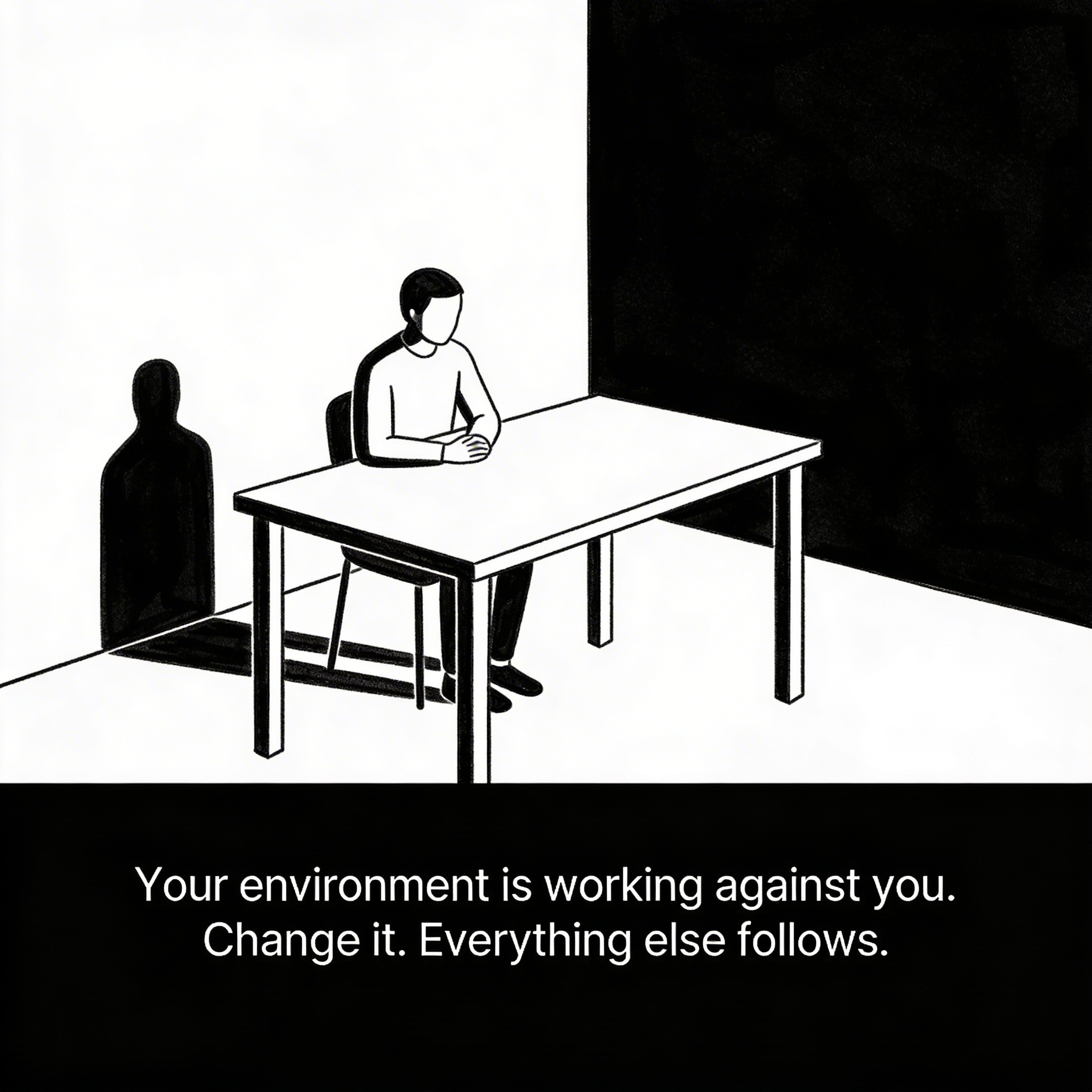
What is the environment you’re doing your most important work inside?
Is it designed for that work?
Or did you just inherit it?
Because most people are trying to do focused, high-quality, creative work inside an environment that was never built for it.
Notifications on.
Phone within reach.
Calendar full of reactive commitments.
No protected time for the work that actually matters.
And then they call themselves undisciplined.
They’re not undisciplined.
They’re working against physics.
The people you admire for their output are not superhuman.
They made decisions about their environment that most people never make.
They protected time before anyone could take it.
They removed the things that competed for their attention before they needed willpower to resist them.
They built a physical and digital environment that made the right work the natural default.
Not perfect.
Not dramatic.
Just intentional.
That’s the whole difference.
You do not need more motivation.
Motivation is emotional and unstable and disappears precisely when you need it most.
You need a setup that doesn’t require motivation.
One where the work is the path of least resistance.
One where your environment does the pushing instead of your willpower.
One morning of real design work on your environment will do more for your output than three months of trying harder.
Most people never do it.
They keep adding force.
They keep asking more of themselves.
And they keep burning out on the same cycle.
While somewhere else, quieter, someone with no more talent and no more hours is producing twice as much.
Not because they’re better.
Because their desk is cleaner.
Their phone is in another room.
Their calendar says no by default.
Their environment is working for them.
Yours is probably working against you.
Change the environment.
Everything else follows.