
The Habits That Add Decades (That Cost Nothing)
A Harvard study followed 100,000 people for 30 years. Five free habits added 12–14 years of life. Here's what they were — and what the longevity industry won't sell you.

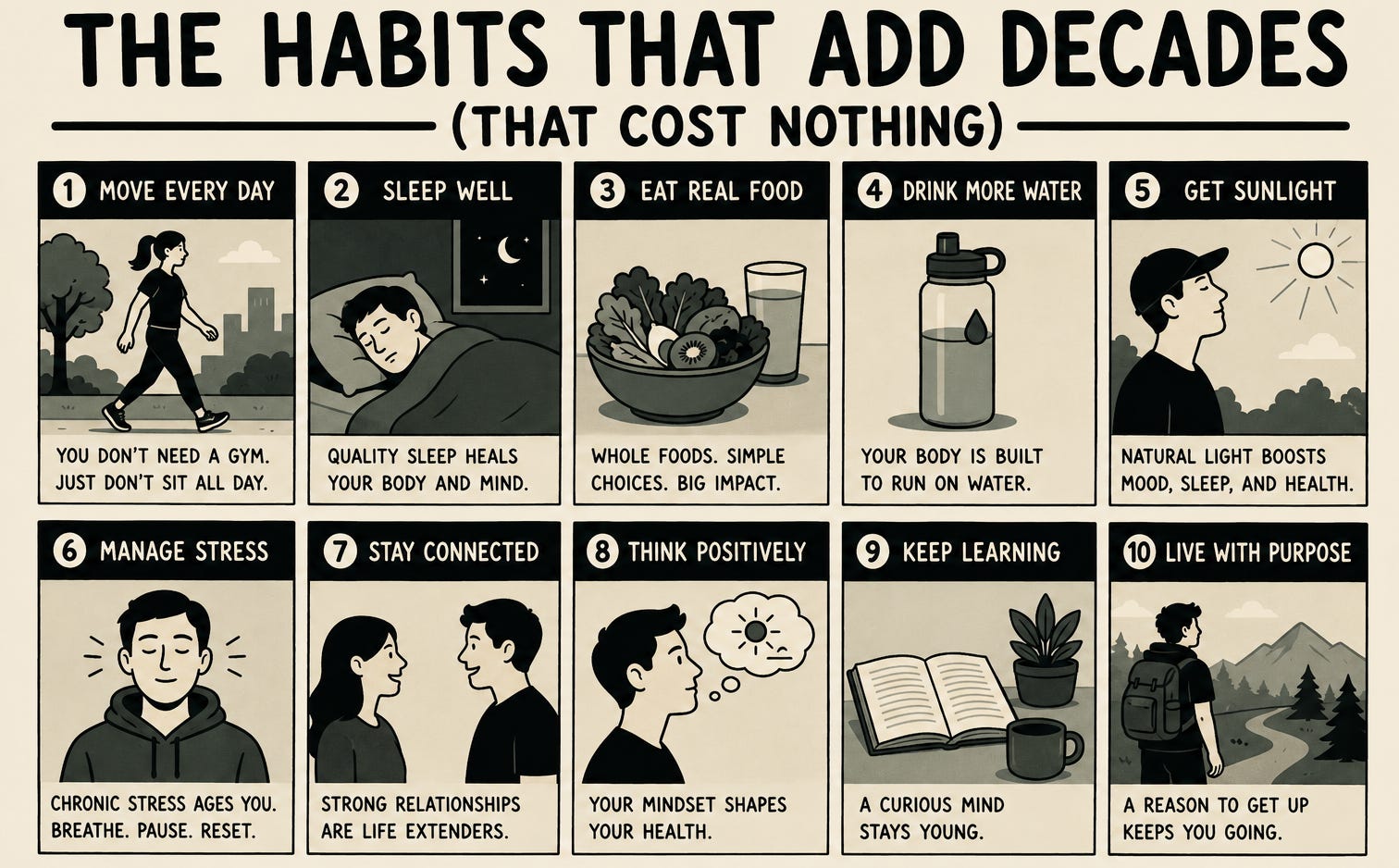
A Harvard team tracked more than 100,000 people for over three decades.
The ones who did five simple things lived, on average, twelve to fourteen years longer than the ones who didn't.
Not one of the five cost a single dollar.
Let me say the uncomfortable part first.
You already know most of this.
You’ve heard sleep more, move more, stress less so many times it’s become background noise, and you’ve quietly decided that because it’s obvious, it must not be powerful.
That’s the most expensive assumption you’ll ever make.
The boring, free habits are the ones with the actual data behind them, and the expensive ones you’re chasing instead mostly have a marketing department.
The longevity you want isn’t for sale.
It never was.
The Longevity Industry Is Selling You The Wrong Thing
Walk into the modern wellness world and you’ll get hit with a wall of price tags.
Five-thousand-dollar blood panels.
Cold plunges.
Twelve-supplement stacks.
Red light beds, peptides, continuous glucose monitors for people without diabetes.
The entire industry runs on one quiet trick: Convincing you that a longer life is a thing you purchase, ideally from them, ideally monthly.
The actual research points somewhere far less profitable and far more annoying.
The things that move the needle most are the things nobody can charge you for.
Free doesn’t sell.
That’s the only reason you’ve been ignoring it.
Habit One: Move Your Body Every Single Day
If a pill did what walking does, it would be the most valuable drug in human history and cost a thousand dollars a month.
Regular movement is the single most studied, most reliable lever on how long you live, and the bar to clear is embarrassingly low.
You don’t need a gym, a program, or a coach.
The research consistently shows that going from zero movement to even a daily walk drops your risk of dying early by a startling margin, and the benefits keep climbing from there.
The biggest jump isn’t from good to elite.
It’s from nothing to something.
Sitting all day is the new smoking.
A daily walk is the cheapest medicine on earth.
Habit Two: Protect Your Sleep Like Your Life Depends On It
Because it does.
We spent twenty years treating sleep as the thing you sacrifice to prove you’re serious, and the science came back with a brutal verdict: Chronic short sleep is quietly tied to heart disease, dementia, weakened immunity, and a shorter life.
Seven to nine hours isn’t lazy.
It’s the window where your brain clears out the junk, your body repairs, and your hormones reset.
Skip it for long enough and no diet, supplement, or workout will save you from the damage.
You can’t out-discipline a lack of sleep.
Nobody ever has.
Habit Three: The Predictor Nobody Wants To Hear - Other People
This is the one that surprises everyone, including the researchers who found it.
The Harvard Study of Adult Development followed men for over eighty years, and the strongest predictor of who aged well wasn’t cholesterol, wealth, or genetics.
It was the quality of their relationships.
Separately, a landmark analysis found that chronic loneliness carries a mortality risk comparable to smoking around fifteen cigarettes a day.
Read that again.
Being lonely is, statistically, about as dangerous as a pack-a-day habit.
The people you love are not a distraction from your longevity.
They are the longevity.
Habit Four: Have A Reason To Get Up In The Morning
A reason to exist sounds like a poster, not a health intervention. The data says otherwise.
People with a strong sense of purpose, something they’re moving toward, someone who needs them, work that matters to them, consistently live longer and stay sharper than people who are just drifting.
One JAMA study found that a stronger sense of life purpose was associated with significantly lower mortality across the follow-up period.
The Japanese have a word for this, ikigai, the reason you get out of bed.
It turns out the reason you get up might be part of why you keep getting up at all.
Retire into nothing and the body follows fast.
Aim at something and it hangs on.
Habit Five: Get Outside, Into Daylight And Into Nature
Modern life moved us indoors, under artificial light, on a schedule our biology never agreed to.
The fix is free and sitting right outside your door.
Morning daylight resets the internal clock that governs your sleep, your mood, and your hormones.
Time in nature lowers stress markers and blood pressure in study after study.
You don’t need a forest retreat or a wellness sabbatical.
You need to be outside, in real light, on a regular basis, the way every human before about 1900 simply was by default.
The sun is free.
Your ancestors knew that.
You forgot.
The Habits That Quietly Steal Decades Back
Every one of these has an evil twin, and the twins are everywhere. The chair you’ve been in for nine hours.
The five-hour scroll that replaced five real conversations.
The chronic low-grade stress you’ve decided is just your personality now.
The all-nighter you’re still proud of.
None of these announce themselves as fatal, which is exactly what makes them dangerous.
They don’t take a year off your life in one dramatic blow.
They take it a quiet Tuesday at a time, and you don’t notice the bill until it’s already overdue.
The threats to your life are mostly boring.
That’s why they win.
Why The Free Stuff Beats The Expensive Stuff
Here’s the part the supplement ads will never tell you.
The reason these habits work isn’t that they’re cheap.
It’s that they’re foundational.
You cannot supplement your way out of no sleep. You cannot hack your longevity around loneliness.
You cannot out-cold-plunge a life with no purpose and no movement in it.
The expensive interventions are, at best, the final 5% you optimize after the free 95% is handled.
Almost nobody handles the 95%.
They skip straight to the 5% because the 5% has a checkout button.
Get the foundation right and you won’t need most of the gadgets.
Get it wrong and the gadgets won’t matter.
Start With One. Today
You don’t need to overhaul your life by Friday.
That’s the fantasy that makes people quit by Monday.
Pick one.
Walk for twenty minutes today.
Go to bed an hour earlier tonight.
Text the friend you’ve been meaning to call for three months.
Step outside in the morning light before you touch your phone.
Choose the smallest version of one habit and do it today, then again tomorrow, and let the consistency do the heavy lifting that intensity never could.
Decades aren’t added in a weekend.
They’re added in ordinary days you almost didn’t bother with.
That’s the whole secret, and it’s been free this entire time.
(One honest note: This is the general research picture, not personal medical advice. If you've got specific health conditions, run big changes past an actual doctor first.)
So I’ll ask you the comment-bait question, since that’s the lever we’re pulling:
Which of these five is the one you already know you’re neglecting — and what’s actually stopping you?
Drop it below.