
Stop Optimizing. Start Finishing
You're not building productivity systems. You're hiding inside them. Here's how the optimization trap kills your output, and how to break it in a week.

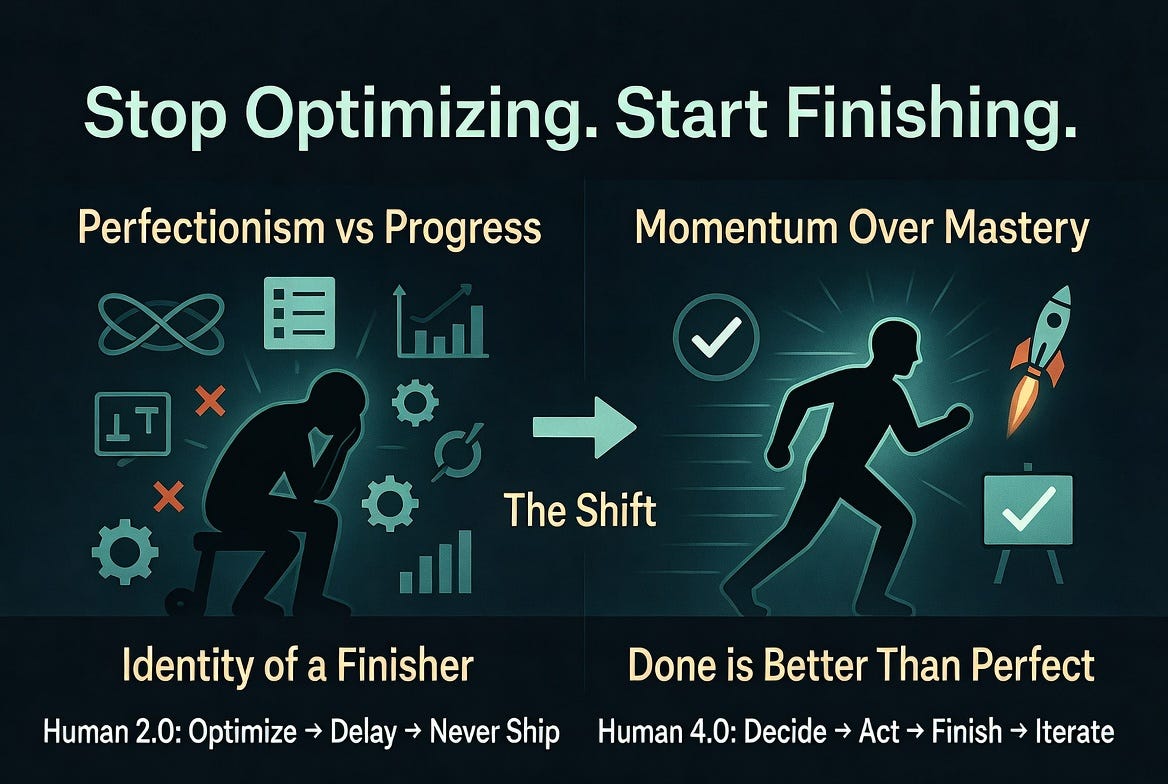
There’s a name for what you’ve been doing all year. It’s not building systems. It’s hiding.
You’ve watched the productivity videos.
You’ve tried Notion, then Obsidian, then Notion again.
You’ve color-coded your calendar, rebuilt your morning routine four times, and bought two books about deep work that you haven’t read because you’re still researching the best note-taking method to read them with.
The dashboard looks beautiful.
The output is zero.
Welcome to the most respectable procrastination on earth.
Productivity Porn Is Procrastination With Better Branding
Optimization is the perfect hiding spot because it looks exactly like real work.
Nobody can call you lazy.
You’ve been “Setting things up” for six months.
Nobody can call you scared, either, because you’re “Designing your workflow.”
You can spend an entire Saturday on it and feel productive, even though absolutely nothing got made, sold, written, shipped, or shown to another human being.
The metrics light up. The dopamine fires.
The world keeps spinning, untouched.
This is the trick.
Why The Optimization Trap Feels So Safe
Real work is uncomfortable in a specific way.
It involves making something that might be bad, showing it to people who might not like it, and watching yourself feel small for a few hours afterward.
Optimization has none of that built into it. Optimization feels like progress and costs you almost nothing: No rejection, no embarrassment, no actual reckoning with whether you’re any good at the thing you keep telling people you do.
That’s why you keep choosing it.
The system is the safe room.
The Second Brain Trap Nobody Wants To Talk About It
People say they’re “Building a second brain” the way alcoholics say they’re having a quick drink.
It started as a useful tool and quietly became the entire activity.
You weren’t supposed to spend six weekends configuring tags. You were supposed to write the essay.
Somewhere along the way, the scaffolding became the building, and you started living inside the toolbox instead of the house.
You can spot this from a mile away once you know what to look for.
How To Recognize The System-Builder Who Never Ships
The person with the perfectly organized Notion who hasn’t published anything in two years.
The aspiring filmmaker who’s seen every camera review on YouTube but hasn’t filmed a single scene.
The writer with three running notebooks, a Substack template, and not one finished essay.
The entrepreneur who’s been validating the idea for fourteen months.
The fitness guy who’s been researching the optimal routine since the last time he set foot in a gym.
All of them feel busy.
None of them are working.
Every Hour Of Optimization Is An Hour Of Evidence
The honest reframe is this.
Every hour you spend on the system is an hour you didn't spend on the thing the system was supposed to enable.
Every hour of optimization is an hour of avoidance wearing better clothes.
You’re not preparing to start. You’re starting.
You just picked the wrong activity.
And then you stretched that activity out over years until it slowly became your personality.
The system never had to be that big.
Why The People Who Actually Ship Use Ugly, Simple Tools
Here’s the part nobody wants to say out loud.
Most output requires a system that fits on a Post-it note.
Open the doc. Write the thing.
Post it.
The cleanest writers I know use a beat-up Apple Notes and a habit. The best small businesses I know run on a spreadsheet that would make a McKinsey consultant cry.
The people who actually ship use boring, ugly, embarrassingly simple tools, because they care about the output and not the workflow.
Complexity is what you reach for when you’re not ready to be judged.
What’s Actually Stopping You (Hint: It’s Not Your Tools)
You already know this. Some part of you, the part that’s still honest at one in the morning, knows that you’re not blocked by a lack of tools.
You’re blocked by the fear of what happens when you finally make the thing and it isn’t as good as you imagined in your head.
The blank page is terrifying.
The half-finished draft is worse.
The published version, sitting out there in public for anyone to see, is the boss fight you’ve been training for without ever actually walking into the arena.
Optimization is how you stay in the training montage forever.
How Optimization Quietly Keeps You Small
There’s another layer underneath this.
Optimization keeps you small in a way that feels expansive.
You get to feel like a serious person, a strategic person, someone who’s thinking long-term and building something real.
Meanwhile, the actual real thing you could be building is sitting in a drafts folder, waiting for the moment you stop fiddling with the tagging structure and just write the paragraph.
The longer you optimize, the bigger that imaginary final project becomes, until eventually it’s so large in your head that you can’t possibly start it.
You inflated the dragon yourself.
You did this. You can also undo it.
How To Escape The Optimization Trap (Start With Constraints)
The fix isn’t another system. The fix is the opposite.
The fix is going so brutally minimal that there’s nowhere left to hide. Pick one project.
One.
Give yourself a deadline you can’t reschedule.
Use the worst, ugliest, most embarrassing tool you can find.
Phone notes.
A Google Doc with one font.
A notebook with coffee stains. The point isn’t elegance.
The point is finishing.
Constraints make people.
Optionality eats them.
What Happens When You Finally Stop Tweaking
You’ll feel something strange when you start working this way.
A kind of nakedness.
Without the tinkering, without the dashboards, without the perfectly themed workspace, you have to actually face the work.
And the work, once you face it, isn’t nearly as scary as the years of avoidance had made it seem.
The dragon turns out to be a lizard.
The boss fight turns out to be one bad first draft, then a slightly less bad second one, then a third one you don’t completely hate.
That’s the whole game.
Why Finishing Bad Work Beats Optimizing Good Plans
Finishing has compounding effects that optimization never will. Every finished thing teaches you something no tutorial can.
What your actual style is.
What you actually care about.
What kind of work you actually want to make.
A finished thing also has a strange way of opening doors.
The half-built second brain has never gotten anyone a client.
A published essay full of typos has launched entire careers.
Done is the only teacher that ever showed up.
How The Productivity Industry Profits From Your Procrastination
The optimization industry counts on you not noticing this.
There’s an entire economy built around selling you the feeling of progress without any of the cost.
Courses on systems.
Books on routines.
Apps that promise to be the last tool you’ll ever need.
Every one of them is profitable precisely because it doesn’t make you finish anything.
A customer who finishes things doesn’t need the next product.
A customer who’s building his workflow forever is a subscription that never churns.
You are the product.
The system is the bait.
When Tools Help vs. When They Become The Problem
This isn’t an argument against tools. Tools are great.
A clean doc, a quiet inbox, a calendar that knows when you sleep, all of it can help.
The question is whether the tool is in service of the work, or whether the work has quietly been demoted to a justification for the tool.
If you’re spending more time arranging the kitchen than cooking, you are not a chef.
You are an interior decorator pretending.
The kitchen exists to feed people.
A One-Week Experiment To Break The Loop
Try this for one week.
No new apps.
No new courses.
No new productivity videos.
Pick the thing you’ve been getting ready to do for the last six months and just do it, badly, in whatever tool is already on your phone.
Set a timer for ninety minutes.
When it goes off, hit publish, send, share, ship.
Don’t read it back.
Don’t tweak it.
Just let it exist in the world.
Why You Need To Ship Something Bad As Soon As Possible
You’ll hate the result. That’s fine.
That’s actually the point.
The version of you who has shipped something bad is a fundamentally different person from the version of you who has only ever shipped nothing.
He’s been through something.
He’s seen the worst-case scenario, the embarrassment and the silence and the one critical comment, and he’s still here.
The fear loses most of its grip the moment you find out it’s survivable.
After that, you can finally start working.
The Only Productivity System That Has Ever Actually Worked
Stop building the perfect system.
The perfect system is a finished body of work, and you cannot build that from the outside.
You can only build it by piling up finished thing on top of finished thing, ugly and imperfect and a little embarrassing, until one day you look back and realize a system emerged on its own.
Your system.
Shaped by your output, not by somebody else’s template.
That’s the only kind of system that ever did anything for anyone.
The dashboard can wait.
The template can wait.
The optimization can wait.
The work cannot.