
Stop Journaling. Start Living: Why Over-Journaling Is Secretly Sabotaging Your Growth
Most people journal to feel productive. The truth? It’s often sophisticated procrastination. Here’s how to stop documenting your life and start designing it.

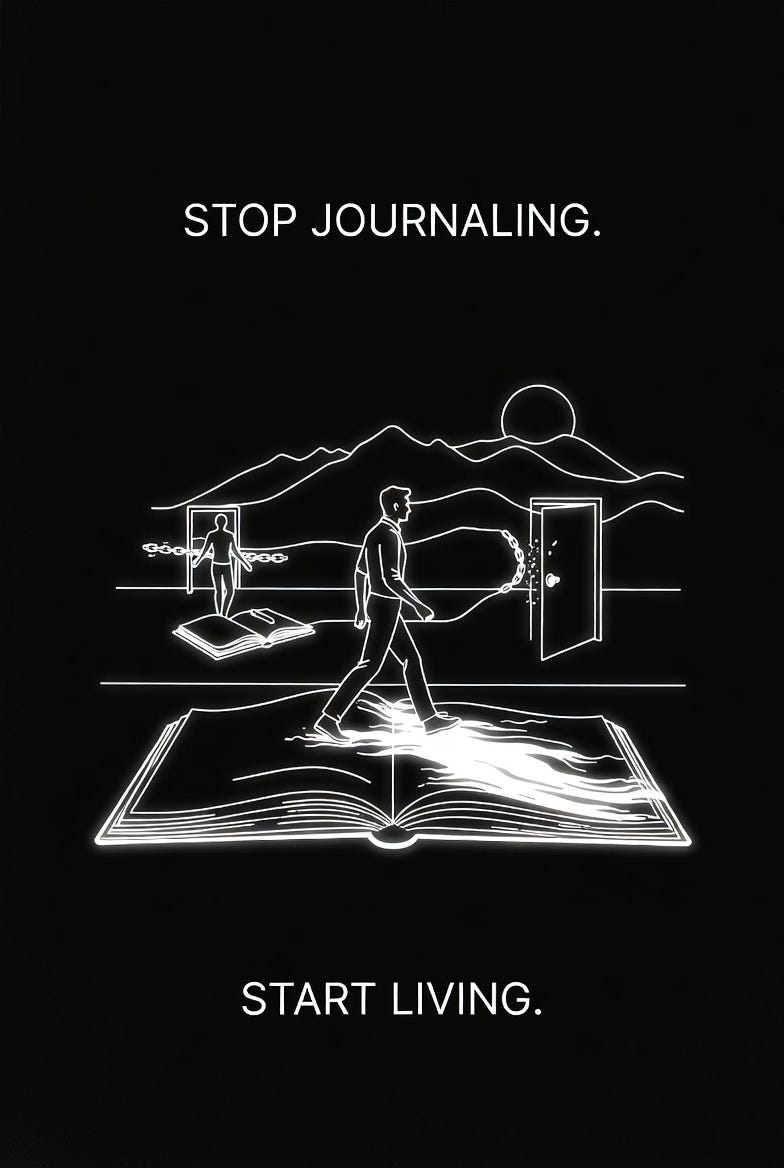
For years I was that guy. Morning pages.
Capture-everything protocols.
Future-self notes.
End-of-day reviews that turned into full essays in my second brain.
I genuinely thought I was doing the inner work.
But one day I looked around and realized something that kinda pissed me off:
My second brain was overflowing with insights.
My actual life?
Not so much.
The gap between the person I was documenting and the person I actually was kept getting wider.
And all those notes were the thing keeping that gap alive.
Here’s what nobody in the productivity world tells you about building a second brain...
It feels like progress.
It isn’t progress.
It’s sophisticated procrastination dressed up as knowledge management.
You get the dopamine hit of “working on yourself” without ever having to risk anything in the real world. No rejection. No failure. No awkward conversations.
Just you, your perfectly tagged notes, and the warm glow of “at least I’m building my second brain.”
But real growth?
That shit happens when you close the app and step into the arena.
Brain Illusion
When you capture every thought in your second brain, your mind thinks you’ve solved it. You haven’t.
You’ve just moved it from your head to the cloud where it can live rent-free forever.
When you write “I need to be more disciplined” in your notes, you feel like you’ve taken a step.
You haven’t.
You’ve just negotiated with yourself on a digital page and called it a win.
When you process an emotion for 20 minutes in a note, you feel lighter.
But the emotion is still there — you just gave it a nicely formatted home in your second brain instead of actually feeling it and moving through it.
This is why so many chronic second brain builders stay stuck for years.
They’ve turned externalization into a lifestyle instead of a tool.
Dan Koe talks about self-architecture — designing who you become through the actions you take, not the thoughts you document.
The more I paid attention (And the more second brains I saw), the more I noticed the pattern:
People with the most sophisticated second brains... often have the least interesting actual lives.
The Shift That Actually Changes Things
Here’s the move, plain and simple:
Stop using your second brain as the main character in your growth story.
Start using your actions as the main character.
You don’t need to capture every insight. You need to become the insight through repetition in reality.
Instead of noting “I want deeper relationships,” you text the person you’ve been avoiding and say “Hey, I’ve been thinking about you, want to grab coffee this week?”
Instead of writing about your fitness goals for the 100th time, you put your shoes on and go for a walk.
No entry required.
Instead of “Processing” why you’re procrastinating in your notes, you set a 5-minute timer and do the first tiny piece of the task.
Your second brain becomes a support tool, not the main event.
Quick brain dump when your head is loud? Cool, do it.
Capturing a random idea before it disappears? Smart.
But the daily “Let me reflect on my entire existence for 30 minutes in my second brain” ritual?
That’s the trap.
That’s what keeps you safe and stuck.
What To Do Instead (The Practical Protocol)
If you’re ready to test this, here’s exactly what I do now. No fluff. Just what actually works:
1. Morning? No pages. No capture ritual.
I wake up, make coffee, and decide the ONE thing I’m going to actually do today that moves my life forward.
Then I go do it.
No notebook.
No app.
Just the decision and the action.
2. During the day? Only voice notes or quick bullets when it truly matters.
If something important happens or I have a thought I don’t want to lose, I whisper it into my phone or just three words. That’s it. No essays.
No deep dives.
No “This could be useful later” hoarding.
3. Evening? 5-minute review max.
At night I spend literally five minutes asking: “What did I actually do today? What did I learn from it?”
Then I close the app.
No deep dive unless something genuinely life-altering happened.
4. The weekly audit (The only time I open the second brain on purpose).
Once a week I look at my calendar and my real results, not my notes.
What actually happened?
Where did I show up?
Where did I hide?
That’s the only data that matters.
5. When the urge capture hits.
Every single time I feel the pull to open my second brain about a problem or goal, I ask myself one question:
“What’s the smallest real-world action I can take in the next 10 minutes instead of capturing it?”
This one question alone has done more for my growth than five years of second brain building ever did.
The 30-Day Challenge
Try this for 30 days. I’m not asking you to delete your second brain.
I’m asking you to run the experiment:
• Keep second brain use to under 5 minutes total per day (Brain dumps only when necessary)
• Every time you want to “process” or capture something, take a real action instead
• Track one real metric that actually matters (Hard conversations had, workouts completed, projects shipped, money made — whatever moves the needle)
• At the end of 30 days, compare how you feel about your actual life vs how you felt 30 days ago
I bet you’ll notice something wild:
Your life will start feeling more alive.
Not because you have a better organized second brain.
Because you finally stopped performing self - improvement in your notes... and started doing self - improvement in real life.
The most sophisticated second brain in the world can’t compete with a life well-lived.
So here’s my challenge, to you friend:
Close the app.
Open the door.
Go live the story instead of capturing it.
You’ve got this.
Now stop reading about it and go do something.
This week, every time you feel the urge to open your second brain…
Take one real action instead.
Then hit comment and tell me what you did.