
How To Use AI Without Getting Dumber
AI is advancing every day, with new tools, agents, and more appearing constantly. Have you ever wondered how to use AI without becoming less sharp? I ask myself that question all the time.

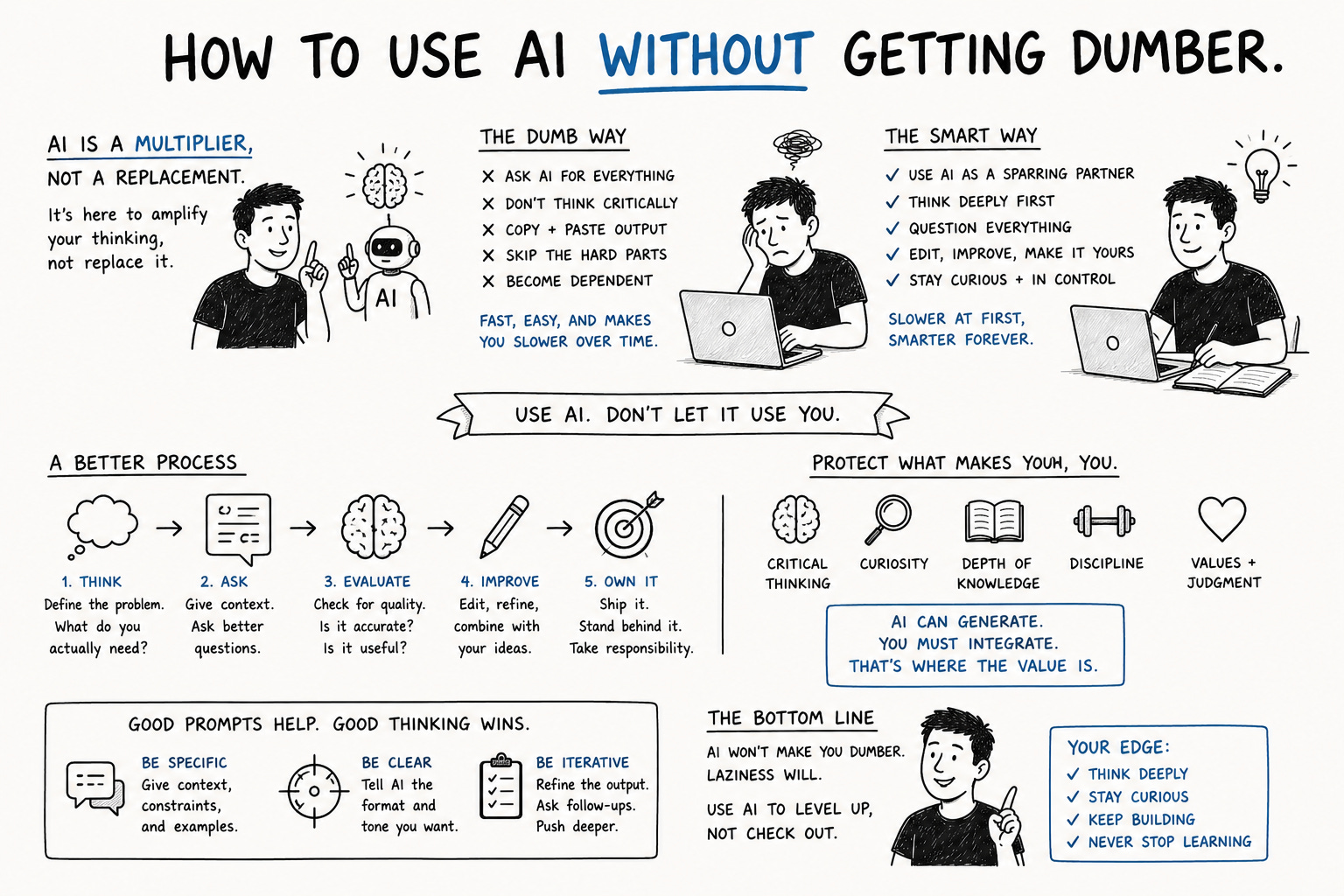
Here's the uncomfortable truth nobody wants to put in a LinkedIn post:
Most people are going to get dumber because of AI.
Not in some sci-fi, brain-rotting, Black Mirror way.
It’ll be quieter than that.
They’ll just stop thinking.
They’ll stop wrestling with hard ideas.
They’ll stop sitting in the discomfort that used to forge their best work, because now there’s a button that gives them something “good enough” in three seconds.
And good enough is the most expensive trap in the world.
Because while most people are settling for good enough, a small group is using the exact same tool to get sharper, faster, and more interesting than they’ve ever been. Same AI. Same prompt box. Two completely different outcomes.
The difference isn’t the tool. It’s the relationship you build with it.
Let me show you what I mean.
The Trap Nobody Wants To Tell You About
Your brain is basically a muscle. Not literally — but functionally, yeah. The more you use it, the stronger it gets.
The less you use it, the weaker it gets.
That's the whole game.
That’s the whole point.
Now plug AI into that.
Every time you let ChatGPT write the email you could’ve written yourself, you skipped a rep.
Every time you ask it to summarize the article you could’ve actually read, you skipped a rep. Every time it solves a problem you could’ve sat with for ten minutes and figured out yourself, you skipped a rep.
One skipped rep is nothing.
But what about a hundred a day? A thousand a week? Over a year? Over a decade?
That’s the trap. And it’s sneaky because each individual moment feels like a win.
You’re “saving time.” You’re “being productive.” Meanwhile, the thing that actually generates your value — your capacity to think — is quietly atrophying in the background.
The tool isn’t the problem.
Outsourcing the thinking is the problem.
Think First, Prompt Second
Most people open ChatGPT and immediately start typing. That’s the first mistake.
Try this instead.
Before you open AI for anything that actually matters, take five minutes — just five — and take a swing at it yourself.
Write the rough draft. Sketch the idea.
Try the answer. Make a list.
Whatever the task is, attempt it before you ask the machine.
You'll be bad at it. That's literally the point.
Because now when you bring it to AI, you're not asking it to do your thinking.
You're asking it to react to your thinking.
That's a completely different relationship.
You go from being a passenger to being a driver using GPS.
The car isn't choosing where you're going anymore. You are.
When I do this, the output is always sharper. Always.
Because I already know what I’m trying to say — I just want help saying it better. The AI becomes an editor instead of a ghostwriter.
And that’s the version of this tool that doesn’t quietly hollow you out.
The frame is simple: AI works best as your second draft, not your first.
Use It Like A Sparring Partner, Not A Crutch
Here’s a question that completely changed how I use AI:
Am I using this to think harder, or to think less?
From the outside, those two paths look identical.
Same tool, same screen, same prompt box.
But they lead to wildly different places over time.
Thinking harder sounds like: "Here's my argument. Fortify the opposing argument. Where am I weakest? What would a smart critic say?"
Thinking less sounds like: "Write me a 500-word post about productivity."
The first one expands you. The second one shrinks you.
One of them you walk away from with new ideas you didn't have before.
The other one you walk away from with content you didn't earn.
The best way I’ve found to use AI is as a sparring partner.
You bring it your half-formed thoughts, your messy drafts, your weird theories — and you ask it to push back.
Find the holes. Play devil’s advocate.
Ask the questions you didn’t think of asking yourself.
That’s where the real upside is.
Not in the answers it hands you, but in the better questions it forces you to ask.
A good sparring partner makes you tougher. They don’t fight your fights for you.
Friction Is A Feature, Not A Bug
Here’s something modern productivity culture has completely backwards.
Friction isn’t bad. Friction is where you grow.
The struggle of staring at a blank page — that's where you find your voice.
The pain of trying to explain a complicated idea simply — that's where understanding actually gets built.
The frustration of debugging code for two hours — that's where you really learn how the system works.
Strip all of that away and you don’t get a more productive person. You get someone with a smoother brain. Less callus.
Less capacity. Less depth.
So when I’m using AI, I’m constantly running this filter: Is this friction I should remove, or friction I should keep?
Boring email replies? Remove the friction. I don’t need to grow as a human there.
A piece of writing I actually care about? Keep the friction.
That's literally where the version of me I'm trying to become gets built.
Same with hard problems in my work. Same with new skills I'm trying to learn.
Same with ideas I haven't fully figured out yet.
Skipping the struggle there means skipping the growth. You're trading the long-term version of yourself for the short-term feeling of progress.
The rule is simple: Outsource the work that doesn't make you better. Protect the work that does.
Most people get this exactly backwards. They use AI to skip the parts that would've made them sharper, and grind manually on the parts that don't matter.
Don't be them.
Read More, Not Less
This is the move almost nobody is making, and it's quietly becoming the biggest unfair advantage you can build right now.
In a world where everyone is reading AI summaries, the person actually reading the books wins.
In a world where everyone is skimming, the person reading slowly wins.
In a world where everyone is outsourcing their inputs, the person carefully curating their own inputs wins.
Why? Because AI can only remix what's already been said.
It's a mirror, not a source.
Your thinking only gets as interesting as the raw material you feed into your own head.
If your inputs are average, your outputs will be average — even with the best AI in the world doing the work for you.
The people who'll dominate the next ten years aren't the ones with the best prompts.
They're the ones with the most interesting minds. And interesting minds aren't built by AI.
They're built by reading deeply, thinking slowly, having weird hobbies, and connecting ideas across fields most people would never connect.
AI didn't kill the value of reading. It multiplied it.
Because now the rare thing isn't information access — everyone has that. The rare thing is a mind worth running that information through.
So read the books. The whole books. Take notes by hand. Sit with hard ideas longer than feels comfortable.
Build the kind of inner library that the AI is downstream of.
That’s where your edge lives.
AI Can’t Give You Taste
Here's a thing that's becoming more true every month: AI can produce infinite content, but it can't produce taste.
Taste is what tells you which output is actually good. Which idea is worth pursuing.
Which sentence sings and which one is dead. Which version of the design you should ship and which one you should kill.
AI will give you ten options.
Taste is what tells you which one matters.
And taste isn't downloadable.
You can't prompt your way into it.
You build it the slow way — by paying attention, by studying work you admire, by making bad stuff and noticing why it's bad, by living a life that gives you something to actually say.
Most people in the AI era are going to have huge output and zero taste.
They'll publish more, ship more, post more — and none of it will land.
None of it will mean anything.
Because they confused volume with value.
The play is the opposite.
Use AI to handle the output.
Spend the time you save on developing your taste.
Read the great writers. Watch the great films.
Look at the great work in your field and ask why it works. Make the thing yourself, badly, before you let the machine make it for you.
Taste is the moat.
Don’t trade it for a faster horse.
The 80/20 Of Not Getting Dumber
If you remember nothing else from this, remember these five rules. They're the actual playbook.
One. Think before you prompt. Always take a swing at it yourself first. Five minutes minimum, even when you don't feel like it.
Two. Edit, don't generate.
Use AI to refine your stuff, not produce it from scratch. Your voice is the asset.
Don't trade it for a generic one.
Three. Make it argue with you. Ask it to challenge your ideas, not validate them. Echo chambers make you weak.
Real pushback makes you sharp.
Four. Keep the friction that makes you better. Outsource the friction that doesn’t.
Know the difference, and be honest with yourself about which is which.
Five. Build your inputs. Read real books. Have strange hobbies. Talk to interesting people. Get bored sometimes.
The AI is downstream of who you are, and who you are is built off-screen.
Follow those five and AI becomes the best thinking tool ever invented.
Ignore them and it becomes the most expensive way ever invented to feel productive while becoming forgettable.
The Real Choice You’re Making
Here’s what I want you to sit with for a second.
AI isn’t the question.
AI is the multiplier.
It takes whoever you already are and amplifies it.
If you’re a thinker, it’ll make you a better thinker.
If you’re a builder, it’ll make you a better builder.
If you’re someone who outsources, it’ll make you outsource even more, even faster, until there’s barely anything left of the thinking part of you.
The tool just turns up the volume on whatever was already there.
The tool is neutral.
The relationship you have with it is not.
So every time you reach for it, you're not just deciding what to type.
You're deciding what kind of mind you're building.
Every prompt is a vote.
Every shortcut you take or don't take, every rep you skip or don't skip, every moment you choose to think or to outsource — it all adds up.
Quietly.
Daily.
Forever.
Ten years from now, there will be two groups of people walking around.
The ones who let AI do their thinking for them, and the ones who used AI to think better than they ever could alone.
There’s no third group.
There’s no neutral middle.
You’re already in one or the other based on how you used it today, and yesterday, and the day before that.
The good news is it’s still early.
The patterns aren’t locked in yet.
The split is happening in real time, and you get to choose which side you end up on.
So choose well.
Your future brain is watching.
Reply to this article down in comments, I read every comment and reply as much as I can.