
Build A Mind You Actually Want To Live Inside
Learn how to build a better mindset, think more clearly, and create a mental environment that supports focus, discipline, and long-term growth.

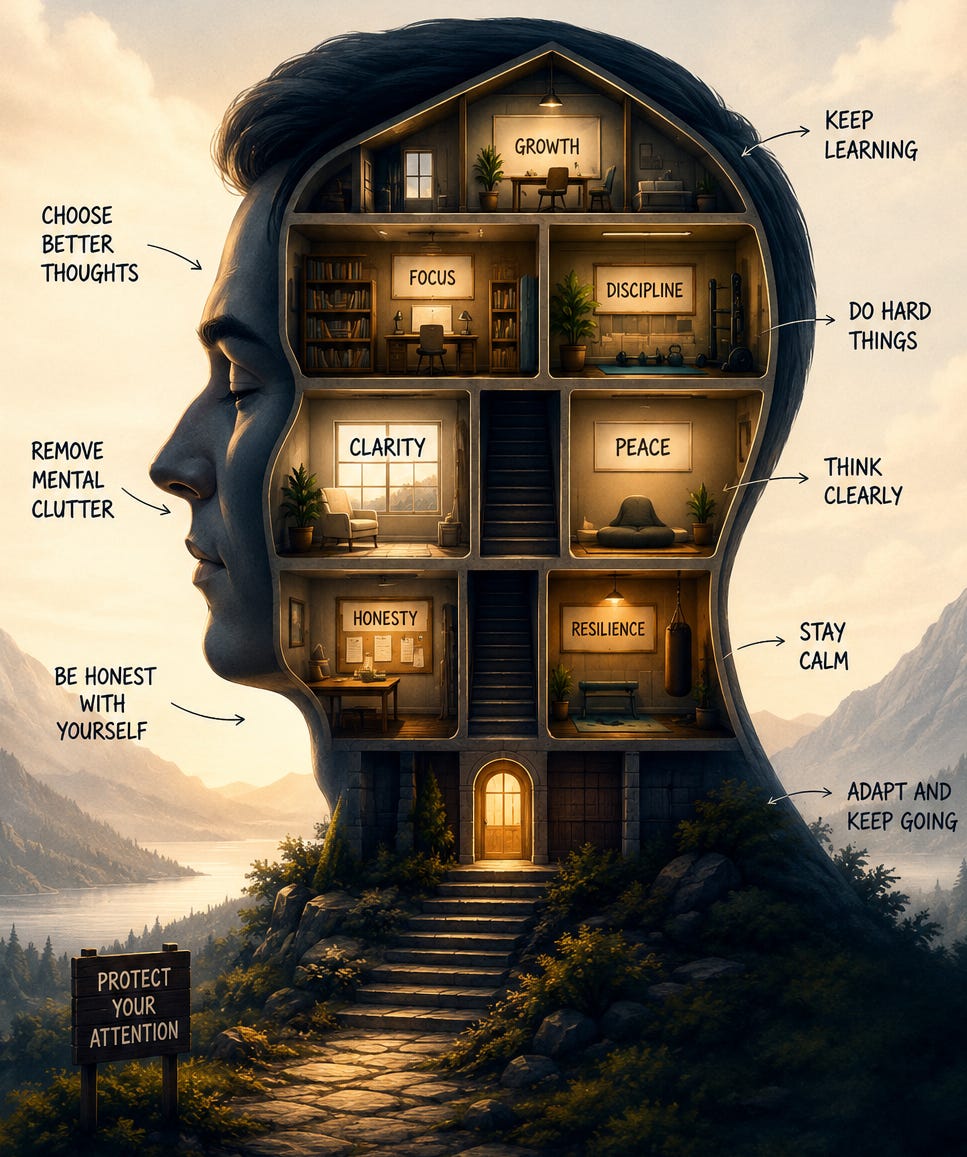
You spend roughly 16 waking hours a day inside your own head.
If that head were a house, would you actually want to live there? Most people, if they sat down and were honest about it, would say no.
The lights flicker, the walls are plastered with other people’s opinions, and there’s a TV in every room playing ads they never asked to see.
Somewhere in the basement, an old version of them is still rehearsing arguments from 2017.
That’s Where You Wake Up Tomorrow
You didn't choose most of what's in there.
School handed you a worldview before you could spell the word "worldview."
Your parents installed the original software, your friend group did the custom mods in middle school, and the algorithm has been doing quiet renovations behind your back since you were about twelve years old.
What you confidently call "my thoughts" is mostly stuff that moved in years ago and never paid rent.
The First Job Is Noticing That
Most people go their whole lives without noticing.
They feel anxious and assume that's just their personality.
They feel bored and assume the world has nothing to offer them.
They feel resentful, distracted, vaguely sad on a Tuesday morning, and they treat all of it like weather they have no say in.
They never ask where any of it came from, who put it there, and whether they'd keep it if they had the choice.
You Have The Choice. You Always Had The Choice
A mind, like a body, is a system. Systems need consistent energy and attention, or they collapse into entropy.
You can lift weights for a decade and still walk around with a soft mind, running on borrowed beliefs, reacting to inputs you never approved, getting hijacked daily by a feed engineered by a thousand smart people to keep you scrolling.
The gym handles your shoulders. Nothing in modern life handles what's between your ears.
That part is on you.
Start with your inputs.
The accounts you follow, the conversations you have, the videos that autoplay before you’ve finished your morning coffee — those are the contractors building your interior, whether you hired them or not.
Watch outrage bait for an hour and the world looks like it’s ending.
Read someone who actually notices beauty in ordinary things and you start spotting it on your own street.
Most People Never Check What’s On The Walls
This is the part nobody warns you about.
You're not just "consuming content."
You're not just "killing time."
Every video, every podcast, every tweet, every conversation is doing actual carpentry inside your head.
You don't get to opt out of the construction.
You only get to choose the builders. And the builders you've allowed in this year are designing the rooms you'll have to live in for the next twenty.
Curate Like Your Life Depends On It. Because The Quiet Truth Is, It Does
Then write. Open a doc, open a notebook, and start putting your thoughts on a page.
You don't realize how feral your inner monologue is until you try to make it form a sentence and watch the whole thing fall apart in your hands.
Writing is the only tool that lets you walk through your own mind with the lights on, point at things, and decide what stays. Every essay you draft is a small renovation.
Every paragraph is a wall you've moved on purpose.
Writers aren’t smarter than you.
They’re just less crowded.
There’s a reason people who journal seem calmer, why people who write essays seem to have a thicker skin, why the loudest, busiest, most chaotic people you know never seem to write anything down.
Writing forces a fight between you and your own brain. It exposes the bullshit.
It makes you notice the loop you’ve been running for six years, and once you’ve seen the loop, you can never unsee it.
That’s the whole game.
Awareness Is The Only Tool That Ever Worked
Then walk. No podcast, no music, no phone buzzing in your pocket every two minutes.
The mind only reveals itself when you stop drowning it in other people's voices, and the best ideas you'll ever have are sitting just behind the noise, waiting for you to shut up for thirty minutes. You don't need a meditation app.
You don't need a guru.
You need a sidewalk and a willingness to feel a little bored.
Boredom Is How You Meet Yourself Again
We've made boredom the enemy.
Every spare second gets filled — at the red light, in the elevator, on the toilet, during the four minutes the pasta water takes to boil.
The phone has quietly become a pacifier for adults, and we've forgotten what our own thoughts even sound like underneath it.
The first few walks without it will feel strange.
The first few will feel uncomfortable in a way you can't quite name. Keep going.
The discomfort is just your mind learning how to speak in its own voice again, the same way a muscle aches when it's finally being used.
By the third week, you’ll start hearing yourself for the first time in years.
The hardest part isn’t input or output.
It’s deciding who actually gets to live in there.
Most people drift along being whoever their environment shaped them into, and then wonder why their inner world feels like a stranger’s apartment they can’t get the deposit back on.
They never sat down and asked the real question: Who do I want to be when I open my eyes tomorrow?
What kind of person handles this stress?
What does the version of me who actually likes himself even sound like in his own head.
You Can Pick. You Can Absolutely Pick
This is where identity work actually happens, and almost nobody does it.
You can rehearse the version of you who's calm under pressure.
You can rehearse the version of you who finishes things, who keeps his word to himself, who speaks kindly to the part of him that's still a little scared of everything.
You're not faking it.
You're casting a vote, every single morning, for a slightly different person to live in this house with you.
Cast enough votes and one day you wake up and they've actually moved in.
Identity Isn’t Fixed. It’s A Daily Ballot
Nobody teaches this because there's no money in it.
You can't sell a clean mind the way you can sell pre-workout.
You can't put a six-pack of inner peace on a Times Square billboard. T
he whole economic engine of modern life depends on you being just anxious enough to keep buying, just insecure enough to keep scrolling, just distracted enough to never sit still long enough to ask whether any of this is making you happy.
A person who genuinely likes the inside of his own head is a person no algorithm can sell to.
That’s exactly why you should build one.
There’s no finish line on this work.
You’re not building toward some perfect, optimized, final brain that never has a bad day.
Even I can’t build a perfect brain that never breaks down or has a bad day.
This is a life sentence, and we can’t get ripped off by it.
You're trying to make the place a little better to be in this week than it was last week.
A little less reactive.
A little quieter at three in the morning.
A little more honest with yourself when something hurts.
The kind of mind that doesn't fold when life inevitably gets loud, and life always eventually gets loud.
A Mind That Holds Up. A Mind That’s Actually Yours
The compounding is sneaky. You won't notice the changes for the first month.
Then one afternoon, six months in, somebody says something that would've ruined your whole week last year, and you'll just smile and let it pass. ]
You'll catch yourself enjoying a meal without your phone.
You’ll have a thought that surprises you, an actual original one, the kind you used to think only “smart people” had. None of it announces itself. It just shows up, the way muscle shows up: slowly, then all at once.
That’s what a mind worth living inside actually feels like.
A mind you’d actually choose, if somebody walked up and offered you the option.
You always had the option.
You always will.
I read every comment you reply to, no matter how difficult it is. I listen carefully and reply as much as I can.